

Outsmarting the Goat Producer’s Biggest Nemesis
If you raise goats, you already know that your biggest daily headache isn’t fixing broken fences or tracking down escape artists. It’s an invisible, silent enemy hiding right out in your beautiful pastures.
We’re talking about internal parasites—specifically, the notorious Barber’s Pole worm (Haemonchus contortus). This tiny parasite is the ultimate livestock nemesis across the Pacific Northwest, responsible for sudden weight loss, severe anemia, and heartbreaking losses in otherwise beautiful herds.
For decades, the go-to solution was simple: grab a bottle of chemical dewormer from the shelf, treat the herd, and move on.
But biology caught up.
These microscopic worms have developed a massive, terrifying resistance to chemical treatments. We simply cannot rely on a bottle of medication to fix the problem anymore.
The good news? The most powerful weapon we have doesn’t come from a pharmaceutical company. It’s completely free, and it’s already under your boots: strategic pasture management.
By understanding the secret life of a worm larva, you can outsmart their lifecycle, clear your pastures, and keep your herd thriving without over-medicating.
High Stakes and Short Grass: The 4-Inch Rule
To beat the Barber’s Pole worm, we have to look at the world from a larva’s perspective.
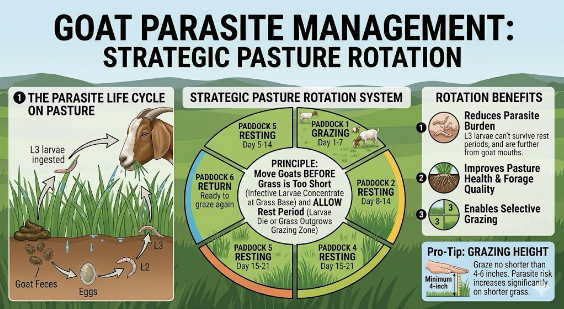
Goats are natural-born browsers. If given the choice, they would much rather eat blackberry briars, brush, and leaves at eye level than put their heads down to eat grass. But when pastures get short, they are forced to become grazers. And that is exactly where the trap is set.
When an infected goat drops manure, thousands of microscopic worm eggs hit the soil. In the warm, damp conditions of a typical spring and summer, those eggs hatch into tiny, hitchhiking larvae.
But these larvae aren’t marathon runners. To travel up a blade of grass, they need a film of moisture—like the morning dew. Even with that moisture helper, they have strict physical limits:
-
- The Huddle: Over 90% of all live, infective worm larvae live in the first 3 inches of grass from the dirt up.
- The Ceiling: They simply run out of energy and dehydrate before they can climb any higher. They almost never make it past the 4-inch mark.
The Golden Rule of Goat Grazing
If you never let your herd graze a paddock down below 4 inches, you effectively eliminate the vast majority of their parasite exposure. You leave the worms stranded at the bottom of the blade.
Step-by-Step: Breaking the Cycle with Rotational Grazing
So, how do we use this biology to protect the herd?
We break their lifecycle by moving the goats through a series of smaller pasture sections, or paddocks, before they have a chance to eat down into that dangerous 3-inch “larva zone.”
Think of it as a game of hide-and-seek where you hold all the cards. Here is how to map out a defensive, rotation-based grazing loop:
1. Divide and Conquer: Step 1
Don’t let your herd have free run of your entire acreage all at once. Use temporary electric netting or permanent fencing to split your pasture into at least 4 to 6 smaller paddocks.
2. Graze the Safe Zone: Step 2
Turn your goats into a fresh paddock when the forage is lush, tall, and standing around 6 to 8 inches high. Let them happily munch on the nutrient-dense top halves of the plants—well away from the soil.
3. The Drop-Dead Red Line: Step 3
Watch the grass height like a hawk. The moment the forage in that paddock is eaten down to 4 inches, open the gate and move the herd to the next section immediately. Do not let them take “just one more bite” at the roots.
4. The Starvation Period: Step 4
Leave the grazed paddock completely empty. Those stranded larvae are sitting at the base of the grass blades, waiting for a goat to swallow them. By leaving the paddock empty for a minimum of 40 to 60 days, the sun, wind, and dry weather will naturally dehydrate and kill the larvae before your goats ever step foot back in that section.
Reading the Herd: Subtle Whispers of a Worm Burden
Even with great pasture management, parasites are sneaky. Because goats are prey animals, they are masters at hiding when they feel sick. By the time a goat looks visibly miserable, slouching in the corner of the barn with a dull, shaggy coat, the infestation is already severe.
The trick is to catch it early by checking their inner eyelids using the FAMACHA scoring system. Grab a handful of animal crackers, head out to the pen, and gently roll down your goat’s lower eyelid.
-
- Bright, vibrant pink or red means they are healthy, red-blood-cell-rich, and winning the fight.
- Pale pink or ghost white means the Barber’s Pole worms are actively draining their system.
As anemia takes hold, protein levels in the blood drop drastically, causing fluid to pool in the lowest point of the body. This creates a soft, saggy swelling right under the jaw line known as “bottle jaw.“
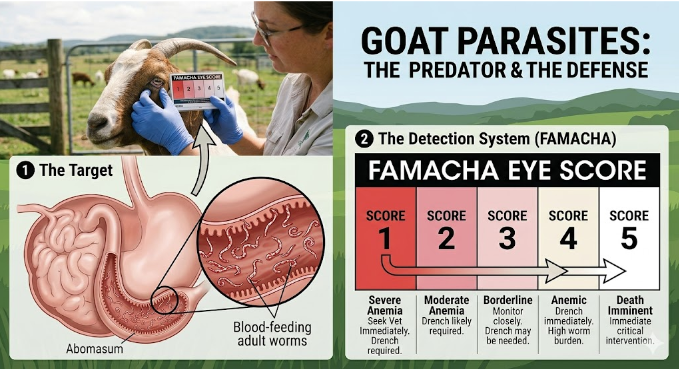
When it’s an emergency: If you see a goat lagging behind the herd, showing a stark white eyelid, or developing a visible pouch of fluid under its jaw, don’t wait.
Call us right away. At this stage, the animal’s red blood cell count is dangerously low, and they need immediate, targeted veterinary intervention to survive the crash.
Creative Co-Stars: Livestock Backups
If you want to take your pasture defense to the next level, look into co-grazing with cattle or horses.
The Barber’s Pole worm is highly species-specific—the larvae that break down a goat’s immune system completely freeze and die inside the digestive tract of a cow or a horse. Running a few steers or a horse through your goat paddocks after the herd moves out acts like a biological vacuum cleaner, safely sweeping the grass clean for the next rotation.
Managing gates, stepping out with a measuring stick, and timing your pasture rests takes a bit of extra effort. But by changing how your goats eat, you take the power away from the parasites, keeping your herd bouncing, healthy, and thriving out in the sunshine.