There is a specific time of year in the Pacific Northwest that makes every horse owner hold their breath. It’s that beautiful week where the gray skies finally part, the mud dries up, and the pastures explode into a vibrant, neon green carpet. Your horses stand at the gate, staring down the lush blades of grass, practically begging you to open the latch.
It feels almost cruel to keep them locked on a dry lot when all that beautiful, free forage is right there.
But as veterinarians, this lush green explosion makes our phones ring off the hook. Behind that innocent-looking clover and ryegrass lies the ultimate spring nemesis: laminitis.
Before you flip the latch on your pasture gate this season, let’s talk about why that beautiful spring growth is a massive sugar rush for your horse’s system—and how you can let them enjoy the sunshine without risking a devastating case of founder.
The Hidden Culprit: Fructans and Hindgut Overload
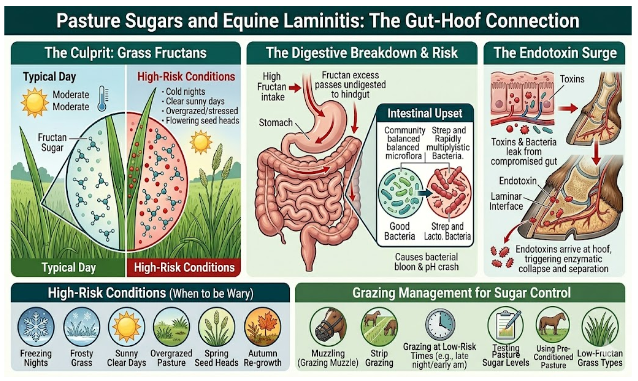 We often think of grass as a simple, high-fiber forage. But in the spring, grass acts more like a candy bar. To grow rapidly, plants use sunlight during the day to manufacture non-structural carbohydrates (NSCs), specifically a type of simple sugar called fructans.
Here is where biology gets tricky.
A horse’s small intestine is designed to process modest amounts of simple sugars. But when a horse gorges on rich spring growth, the sheer volume of sugar overloads the upper digestive tract. The excess spills directly into the hindgut (the cecum).
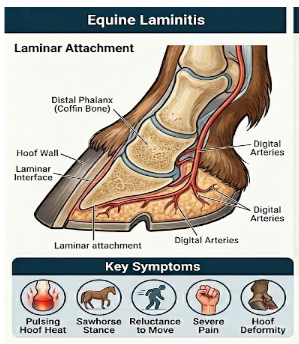
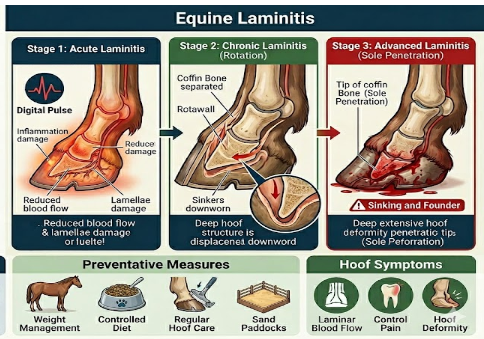
When a massive wave of sugar hits the hindgut, the resident fiber-digesting bacteria panic. They rapidly ferment the sugar, creating an acidic environment that causes a massive bacteria die-off. As those bacteria burst, they release harmful toxins into the horse’s bloodstream. These toxins travel straight to the hooves, disrupting the blood flow and causing the sensitive laminae—the Velcro-like tissues that suspend the coffin bone inside the hoof wall—to fail.
The result is laminitis, an incredibly painful, emergency condition that can cause permanent lameness.
Timing the Melt: The 10:00 AM Rule
So, does this mean your horses can never touch spring grass again? Not at all. It just means we have to outsmart the plant’s natural sugar factory.
Plants produce sugars through photosynthesis all day long, meaning sugar concentrations peak in the afternoon. Overnight, when the sun goes down, the plant safely consumes those stored sugars to fuel its own growth. This means grass sugars are at their absolute lowest right at the crack of dawn.
The Temperature Trap: Keep an eye on your night-time thermometer. If the temperature drops below 40°F overnight, the grass gets shocked. It goes into survival mode and stops growing, which traps all those afternoon sugars inside the blade. If the night was freezing, the next morning’s grass is incredibly dangerous.
Step-by-Step: The “Slow and Steady” Acclimation Plan
The secret to avoiding a spring metabolic crisis is giving your horse’s internal microbes time to adapt. A horse’s hindgut needs roughly two to three weeks to build up the specific bacterial populations required to process a diet shift.
Think of this transition period like training for a marathon—you wouldn’t run 26 miles on day one, and your horse shouldn’t graze for hours on night one.
1. The Teaser Turnouts: Days 1 through 7.
Start by turning your horse out for a maximum of 15 to 30 minutes per day. To prevent them from bolting down the grass on an empty stomach, feed them their normal portion of dry, low-sugar hay before you open the pasture gate.
2. Stepping Up the Minutes: Days 8 through 14.
If your horse shows no signs of foot soreness, increase their turnout time by 30 minutes every other day. By the end of week two, they should be comfortably grazing for about 2 hours—but keep this restricted strictly to the early morning hours before the sun gets high.
3. Bringing in Reinforcements: Days 15 through 21.
As your horse graduates past the 2-hour mark, it’s time to introduce a grazing muzzle. A well-fitted muzzle is a horse’s best friend in the spring; it cuts down their actual grass consumption by up to 80% while still allowing them to walk, stretch, socialize, and behave like a horse out in the sunshine.
4. Know Your Individual Horse: Day 22 and Beyond.
By week four, a metabolically healthy horse can typically handle half-day turnouts. However, if you own an “easy keeper”—like a pony, a Morgan, or a horse with a thick, hard “cresty” neck fat deposit—they should remain on a strict muzzle regimen or a dedicated dirt dry-lot all season long.
Listening to the Hooves: Subtle Whispers of Pain
When laminitis strikes, horses will tell you long before they completely refuse to stand. If you walk out to the pasture and notice your horse walking like they are “stepping on eggshells,” or if they are constantly shifting their weight back and forth on their front feet, their laminae are crying out for help.
If you suspect a flare-up, crouch down and gently wrap your hand around the back of their fetlock joint. If you feel a strong, rhythmic, throbbing pulse—what vets call a bounding digital pulse – it means there is severe inflammation building up inside that hard hoof capsule.
What to do in an emergency:
If your horse is rocking back on its heels, reluctant to move, or spending hours lying down in the stall, call us immediately. While you wait for the vet truck to arrive, pull the horse off the grass entirely and stand them in a deep bed of cold water or ice. Cooling the hooves down immediately can actually halt those traveling toxins in their tracks and save the internal structure of the foot.
Spring is a wonderful season to spend out at the barn. By managing the gate, keeping an eye on the clock, and introducing the green stuff slowly, you can keep your horse sound, happy, and ready for trail riding all summer long.